|
 |
MAINTAINS ZDDP
SAVES ENGINES
REAL
ZDDP |

|
After 70+ years of trouble-free, metal-metal engine
protection, the E.P.A. is forcing ZDDP (Zinc
Dialkyl Dithio Phosphate = Zinc and Phosphorus) from
domestic motor oil. If your engine was designed prior to
the 1990s, your non-roller lifters require ZDDP in your
motor oil to avoid premature deterioration. Don’t let
your lifters run metal-to-metal. Keep ZDDP, via ZDDPlus™,
in your motor oil. Add the 4 fluid ounce contents of
this
ZDDPlus™ bottle at every 4 to 5 quart oil change.
One bottle of
ZDDPlus™
contains more ZDDP than two
bottles of GM’s EOS, which is designed for break-in use ONLY!
|
|
|
Certified Test
Results

Checkout
ZDDP Certified Lab
Test Results - use ZDDP with confidence
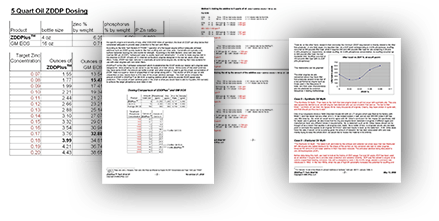
from placing a 4 ounce bottle of ZDDPlus™
into a typical 5 quart (160 ounce) oil tank.
Use ZDDP with confidence!!
|
ZDDPlus™
is a product offered by car enthusiasts to meet the
needs of classic car aficionados. |
|
The automotive industry in general is changing in
response to the environmental and financial
pressures of today, with little concern for the
classic car industry. We are engineers and
automotive technicians by trade, and bring many
years of problem solving experience to the task of
keeping our classic cars operational and running
better than new. We hope that one of the solutions
we have designed for our own use will meet your
needs as well. We have developed
ZDDPlus™
to
address the needs of classic car owners for
an oil that will meet the specifications of
the original oil for which their engines
were designed. |
|
Why do we need
ZDDPlus™ ? |
As part of an effort to reduce vehicle emissions, the U.S. EPA offers
vehicle manufacturers "credits" for early
implementation as well as penalties for violation of
emission reduction standards. The EPA's program
called for 100,000-mile catalytic converter life by
2004, 120,000 miles by 2007, and 150,000 miles by
2009. To achieve these goals, automotive
manufacturers have pressured their oil suppliers to
remove substances from motor oils that would shorten
the service life, including the proven EP (extreme
pressure) additive ZDDP (zinc dialkyldithiophosphate).
Zinc and phosphorus from the ZDDP can be present in
small amounts in the exhaust gas of an engine
depending on the amount of oil which is consumed in
combustion. These elements can coat the catalyst
reducing the amount of catalyst exposed to the
exhaust gases, ultimately increasing emissions at
the tailpipe. As a result of the EPA mandate, the
ZDDP level in engine oils has been declining since
the mid-1990s, roughly coinciding with the
implementation of OBDII.
ZDDP has been an important additive to engine oils
for over 70 years, and has an excellent track record
at protecting the sliding metal-to-metal cam lifter
interface. Historically, ZDDP has been added to oils
in amounts resulting in approximately 0.15%
phosphorus, and 0.18% zinc. ZDDP protects by
creating a film on cams and flat lifter contact
points in response to the extreme pressure and heat
at the contact point. The film of zinc and
phosphorus compounds provides a sacrificial wear
surface protecting the base metal of the cam and
lifter from wear. In the course of normal service,
this conversion of ZDDP to zinc and phosphorus
compounds depletes the ZDDP level in the oil.
Studies show that depending on the specific engine
and severity of duty, after 2000-4000 miles of
operation, the level of ZDDP can drop below that
considered adequate to provide wear protection to
the cam and lifters.
According to the SAE Tech Bulletin # 770087
, operation of a flat
tappet engine without adequate EP additives such as ZDDP quickly leads to lifter foot scuffing and cam
lobe wear. Camshafts are typically only surface
hardened leaving the core ductile for strength.
According to the SAE Bulletin, once cam lobe wear
reaches 0.0002, "subsequent wear is usually rapid
and catastrophic." Two ten-thousandths of an inch is
one fifth the thickness of an average human hair.
In order to make engines last in the absence of ZDDP,
virtually all IC (internal combustion) engines
designed in the last ten years utilize roller
lifters. Today, ZDDP has been removed from
practically all automotive engine oils, rendering
them unsuitable for use with older engines with
non-roller lifters.
Why is it being removed?
Because contemporary engines
with roller bearings no longer
require the additional
protection of Zinc and
Phosphorus. Not true for classic
cars, tractors, muscle cars,
etc. Also removing the Zinc and
Phosphorus from motor oil
increases the life of the
catalytic converter. But classic
cars, tractors, etc., don’t have
cats! Also, as part of its
ongoing effort to reduce vehicle
emissions, the EPA has mandated
that emission systems must have
a service life exceeding 120,000
miles. To achieve this,
automotive manufacturers have
required oil suppliers to remove
additive packages from motor
oils that could reduce emissions
compliance.
ZDDPlus™
is the ONLY EP (Extreme Pressure) component
which re-establishes the ZDDP levels that our
classic car engines were designed for, while
allowing the car owner to use the base oil of their
choice. While some off-the-shelf additives may have
some ZDDP, the amount per bottle is small, and when
enough is used to get the proper concentration of
ZDDP, there is a quart or more of unspecified oil
that comes along with it. This dilution of 20% of
your oil with an unspecified oil also means that
there is 20% less of the proper additive package.
The chart below compares the amount of ZDDP in
ZDDPlus™
to GM EOS, an additive which claims to
provide ZDDP based wear protection.
|

|
What's In Our Oil ? |
As lubrication technology improves, so does the base
oil used in the manufacture of engine oils. Oils are
also changed and updated in response to advancements
in engine technology.
Modern engine oil is a precise mix of a base oil with
additives totaling almost 10% of the oil by volume.
Pound for pound these additives are each more
expensive than the base oil, and oil companies are
in business to make a profit. Common sense says that
these additives are there with good reason.
Modern engine oil is a multi-purpose fluid in an
engine, carrying the heat away from hot spots and
releasing it in the sump as well as providing
lubrication to critical areas which need protection
against wear. Different additives are put in the oil
in order to address the needs of each specific
engine system that is supplied with oil:
The crankshaft and connecting rod
bearings discharge oil into the spinning
reciprocating assembly, and an anti-foaming additive
keeps the oil from turning into foam.
The heat developed on high-pressure
contact areas can exceed the breakdown temperature
rating of the base stock, so heat stabilizers are
added in order to fight viscosity breakdown and
ashing.
In a multi-viscosity oil, the
multi-viscosity characteristic is established by an
additive.
Acids and byproducts of combustion are
neutralized by another additive.
A dispersant additive helps keep
combustion particulates from clumping.
Detergents are added to lower the
surface tension to a specific value to help keep
contaminants in suspension and off of the metal
engine parts. Some detergents also interact with
the EP additive to gain an additional level of wear
protection.
The sliding cam-to-cam-follower
interface in a non-roller lifter engine requires a
special EP additive, which has historically been the
ZDDP that is now reduced in all API rated automotive
oils.
|
ZDDPlus™
contains the proper amount of ZDDP to give at least
0.18% zinc and 0.13% phosphorus level when a single
4 oz. bottle is added to a normal 5-quart oil
change. This level of zinc and phosphorus is the
level designed into pre-OBDII oils. Using
ZDDPlus™
affords you total control over the characteristics
of the oil in the engine by allowing you to use the
full 5 quarts of a high-grade automotive oil of your
choice.. |
|
/td>
|
|
|
What
about off-the-shelf additives and supplements? |
API oils have always been more than adequate for the engines designed when
the oil was current. The use of current API grade
oils has always been adequate to satisfy car
manufacturer's requirements and
warranty
demands. Historically, with few exceptions, newer
API grades have superseded the performance of their
predecessors. The removal of ZDDP has resulted in a
clear change to that philosophy. It has never been
necessary or desirable to include additives or
supplements to any API rated oil to meet car
manufacturer's specifications or warranty
requirements. In virtually all cases, off-the-shelf
additives amount to little more than automotive
snake oil. Current additive technology has yet to
develop an EP anti-wear agent as effective as ZDDP.
Consequently, if these additives actually had
adequate levels of ZDDP, they would be incompatible
with modern engines and void manufacturer's
warranties.
Due to this unprecedented turn of events in
emissions requirements,
ZDDPlus™
should not be confused with an off-the-shelf
additives.
ZDDPlus™
should be considered a replacement for a missing oil
component critical for older cars.
|
|
Current additive technology has yet to
develop an EP anti-wear agent as effective
as ZDDP. |
 |
|
|
Why Add
ZDDPlus™
? |
ZDDPlus™
is not a typical oil additive. By adding a small 4
ounce bottle of
ZDDPlus™
at every oil change, an adequate amount of Zinc and
Phosphorus will continue to protect your classic
engine.
ZDDPlus™
simply maintains the Zinc and Phosphorus
that has recently been removed. |
|
Why Can't We Use Diesel CI/CJ-4 Rated Oils? |
There are some diesel
engine rated oils on the market
which may still have some ZDDP in them. There are problems associated
with using these oils in a normal gasoline engine
which can become severe in a high-performance
gasoline engine. One issue is the high amount of
detergent additive, and another is the high
viscosity.
High detergent oil has a lower surface tension and
lower shear pressure rating which can cause higher
bearing wear in gas engines. A diesel engine needs
oil with very high detergent capabilities in order
to hold the large amount of combustion byproducts in
suspension, but it is not optimized for a gasoline
engine. The bearing journal size-to-displacement
ratio on a gasoline engine is designed around the
use of a lower detergent oil and relies on a
high-shear rating to the oil.
The other problem with high detergent oil is that it
actually reduces the friction reduction that the
ZDDP affords, especially in a high-performance, high
valve spring pressure engine.
The viscosity rating of most diesel rated oils is
higher than optimum for our higher revving gasoline
engines, and can cause oil starvation in bearings at
high rpms. |
|
Why Can't We Use Racing Oils? |
There are some racing oils which
maintain a level of ZDDP. Racing oils are optimized for short term
severe duty, in contrast to an oil that has been
designed for day in, day out street operation. The
additive package in a racing oil does not have the
same detergent characteristics which are designed
into extended service oils. As a result, racing oils
may not have the capability of neutralizing acids
and keeping contaminants in suspension. Also, the
breadth of choice of viscosity, so important to
correct street engine operation over a broad
temperature range, is not available in racing oils.
By using
ZDDPlus™
in addition to a modern high-quality
oil of the proper viscosity for your gasoline
engine, the correct EP lubrication level is
established, and the oil characteristics remain
optimized for your engine.r engine. |
|
FAQ
- Frequently Asked Questions |
|
|
What
is
ZDDPlus™™
? |
ZDDPlus™
is an oil supplement that
contains very high
concentrations of the well-known
additive ZDDP (Zinc Dialkyl Dithiophosphate), which has been
the primary EP (extreme
pressure) ingredient in all
quality motor oils for over 70
years. However, beginning in the
late 1980s, the concentration
has been greatly reduced as
newer oil classifications have
come on the market.
|
Why
do I need ZDDP? |
The EPA has put stricter emission requirements on new
cars that influenced
manufacturers to remove ZDDP
from motor oils. If you have an
older car that was specified to
use SF (1988) or earlier motor
oil, its design requires ZDDP.
Your older performance car could
be damaged with the use of
modern SM oils prevalent today.
Cars equipped with flat tappet
cams need ZDDP because of the
high-pressure points. Newer cars
have roller rockers and ZDDP is
not needed in those applications
|
What
do the oil grades such as "SF" indicate ? |
In the API (American Petroleum
Institute) classification
system, "S" and "C" are the two
basic application categories of
oil. "S" is intended for
gasoline use and "C" is intended
for diesel use.
"A" was the first grade in each
category and resulted in "SA"
and "CA" grade oils. Each
designation progressed farther
up the alphabet as new grades of
oil were introduced. The newest
grades are "SM" and "CJ"
respectively. "SF" was for 1988
and older engines.
|
Aren't
the newer oils better than the older oils? |
Historically, every new grade of oil introduced since
the 1930's was better than the
previous grade and could be
considered "improved" with one
exception. The original SA grade
was straight mineral oil
(non-detergent non-additives)
and SB contained additives which
could not be used in the
earliest cars specified for SA.
While it is true that SM oils
are better for NEW cars, they
are NOT better for the OLDER
cars equipped with flat tappet
camshafts. Simply put, the
newer, better oils are not
backward compatible for older
cars primarily due to the
gradual reduction of ZDDP
starting with SG grade
introduced in 1988. In the next
few years, it will be eliminated
completely from oil.
|
How
much
ZDDPlus™
should I add to my oil? |
One bottle of ZDDPlus™
will raise the ZDDP concentration level of SL or SM oil to the standards
that were in place when SF (or earlier) oil
was specified. (SL and SM is the current
category available today).
|
What
if my oil already has some ZDDP? |
ZDDP is most effective if the concentration
is between 0.18 and 0.2 % by weight. Tests
have shown that concentrations above this
amount, up to as much as several percent,
have no effect except to prolong additive
life. The current oils available today
contain very little ZDDP.
|
Can
I use
ZDDPlus™
with regular or synthetic oils? |
Yes, ZDDPlus™
should be compatible with
all conventional and synthetic oils intended
for automotive use. Virtually all of these
current oils have had some amounts of ZDDP
for years, and it continues to be decreased
in available oils.
|
What
is the shelf life of
ZDDPlus™
? |
The
shelf life of ZDDPlus™
is essentially the same as
regular motor oil (many years), as long as a
few conditions are met. The temperature
should be kept below 120 degrees F and above
0 degrees. You need to keep it sealed until
it is mixed with motor oil. ZDDPlus™
has a tendency to absorb
moisture, not unlike brake fluid. Absorption
of water will degrade its performance,
although heating it above 100C until it is
not cloudy will restore it.
|
When
should
ZDDPlus™
be added? |
Anytime, but the best time is when you get
the oil changed. A single 4-oz bottle is the
correct concentration for a 4- to 5-quart
oil change. This will bring the oil back to
SF specifications.
|
How
long does
ZDDPlus™ last? |
ZDDPlus™
is a sacrificial additive,
meaning that in the process of working, it
is depleted. ZDDPlus™
should last the life of a
normal oil change as specified by the
manufacturer of the car, but attention
should be given to the categories of service
known as "normal" and "severe" conditions.
Severe includes stop-and-go driving and
short trips, which result in shortened
service life of not only ZDDPlus™
, but most of the other additives in the oil.
|
Why haven't I heard more about this problem? |
The general public, as a rule, has nothing to be
concerned about. The people that need to be
concerned are owners of older classic cars
and performance cars. After the SF category,
the amount of ZDDP has gradually been
reduced as each new API category is
introduced. Had ZDDP been removed completely
after 1988 (SF), the scramble for an
alternative would have been a big concern.
But, since it happened gradually, the
concerns were not so obvious.
|
Why should
ZDDPlus™
not be used in OBD cars? |
The key ingredient of ZDDPlus™
is ZDDP, which has been
known to shorten catalytic converter life.
Manufacturers have been redesigning engines
for the last decade to minimize the need for
ZDDP, in order to lower emission levels. One
method is switching over to roller rockers.
|
Why not just use diesel rated oils, since they contain higher levels of ZDDP? |
Diesel engine requirements are much
different that those of gasoline engines.
The higher speeds and lower bearing
surface-to-power ratios of gasoline engines
require oil with higher shear ratings than
most diesel oils. Diesels also have higher
bearing clearances and that calls for higher
viscosity oils. The additional detergents
required for soot control actually reduce
the effectiveness of added levels of ZDDP
found in diesel oils. Also, newer diesel
oils beginning in 2007 have greatly reduced
their content of ZDDP.
|
How does
ZDDPlus™ compare to EOS? |
Historically, EOS was the most concentrated
ZDDP supplement available. It was intended
to boost ZDDP levels of oils that already
contained EP additives. EOS was packaged in
a 16 oz bottle. It also sold for over $10
per bottle. ZDDPlus™
is packaged in a 4 oz
bottle and contains TWICE the amount of ZDDP
contained in EOS, since it is intended to be
used with newer oils that contain little or
no ZDDP. In the summer of 2007, EOS was
discontinued, making it difficult to find
today.
|
What
about the additives offered by the cam manufacturers? |
Some of the "Break-in" or
"assembly lubes" offered by cam
manufacturers contain marginal amounts of
ZDDP while others offer virtually none. In
most cases these products are intended for
initial run-in and rely primarily on other
additives such as MDS (molybdenum
disulfide). These products
are seldom recommended for continued use and
most are intended to be removed before the
engines are put into service.
|
What about off-the-shelf oil additives? |
Automotive engines
have always been designed and warranted to
work properly with the current available oil
at the time of manufacture. There has not
been a single off-the-shelf additive shown
to perform any beneficial function except
financial gain to the additive seller.
Unlike other additives that have never been
recommended by manufacturers, ZDDPlus™
is a replacement for the long-used
component of oil that manufacturers once
required, but over the years have been
forced to remove from the oil for the
benefit of newer cars at the expense of
older cars.
|
What
about the claims of the various additives? |
The performance record of ZDDP is well
established. We make virtually no claims for
ZDDPlus™
, EXCEPT that it restores the EP (extreme
pressure) function of the oil to the level
originally required for your older car.
Other additives make claims so ludicrous;
they cannot be accepted based on common
sense. If the claims attributed to most
additives were even partially true they
would have been part of the standard
crankcase fill directly from the
manufacturers like ZDDP has been for
decades.
|
Where
can I learn more about ZDDP? |
A quick search of Yahoo or Google will
immediately provide one with numerous sites
that deal with this subject. Most sites are
credible although many date back several
years to a time when things were not as
critical as they are now in 2007. |
|
|
|
 |
|
 |
|